News
Beyond the Numbers: The Human Impact of WasteAid’s Work
Members of WasteAid’s Gambia team, Lamin Janneh and Jojo Saho, recently investigated what our programmes mean to our individual participants by speaking to members...

Members of WasteAid’s Gambia team, Lamin Janneh and Jojo Saho, recently investigated what our programmes mean to our individual participants by speaking to members of WasteAid’s plastic collection groups in the Greater Banjul Area. These groups are trained and supported through a generous grant from Veralto.
At WasteAid, we believe that tackling waste can transform lives. While our work reduces landfill sites, improves safe waste collection, prevents plastic pollution, and creates livelihood opportunities through waste management, its greatest impact is felt within the lives of the vulnerable in these communities. From parents being able to afford their children’s education, to providing food security, the benefits extend far beyond cleaner environments. These are the stories at the heart of our work.
In The Gambia, WasteAid’s First Step Resource Management Programme, supported by Veralto, is helping communities establish local systems to collect and recover plastic waste. But behind that relatively simple description is something much more human.
A recent study spoke to 14 people from seven WasteAid-supported waste collector groups. The average person interviewed was supporting a household of 13 people, including nine dependants. Eight of the 14 participants were women. And their experiences show just how far the impact of better waste management can reach.
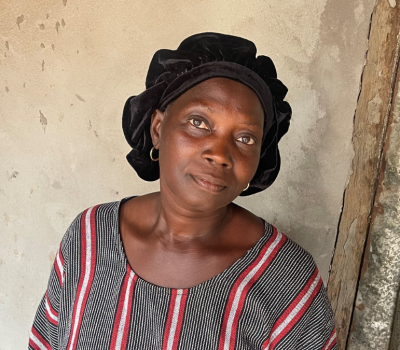
For Ndey, it means security throughout the year
Ndey Manga, a member of the Sanyang Group, collects plastic alongside oyster harvesting. Oyster harvesting can provide a good income, but it is seasonal. When the season ends, so does that source of money. Plastic waste, by contrast, is there throughout the year. For Ndey, that makes waste collection more than an additional job. It provides another layer of security for her household.
 “The plastic waste collection business is more sustainable than oyster harvesting because it provides income throughout the year.”
Her experience is reflected across the groups. People combine plastic collection with informal trading, fish processing, construction, oyster harvesting and small businesses. Many of those income sources are seasonal or irregular. Plastic collection can provide something extremely important alongside them: a more consistent source of income.
And sometimes a relatively small amount makes a surprisingly big difference.
Participants told us that an additional D500–720 a month – around £5–£7 – could meaningfully improve their household finances. That money could contribute towards food, school fees, uniforms and books. It could help meet an unexpected healthcare expense. It could reduce the need to borrow in an emergency or allow a family to put a little money aside.
One participant described the security of receiving that income very simply:
“Receiving the income feels like having savings when I need them.”
For Mama, it means living somewhere cleaner
The benefits are not only financial. Mama Camara, from the FANDEMA Group, remembers what happened to plastic waste before the programme. It was commonly discarded or burned. WasteAid’s training has helped change her understanding of that waste – and what her community can do with it.
“We now have a cleaner environment. Before, we used to burn plastics, but since this project started, we are much more aware of the dangers of plastic waste.”
That is an important part of the human impact of waste management too.
Globally, one in three people has no waste collection service, leaving many communities with little alternative but to dump or burn their waste. WasteAid works with communities, waste collectors and local authorities to create practical collection and recycling systems where they are needed.
For the people living there, success is not an abstract environmental outcome. It means the place where their children play is cleaner. It means less plastic being burned close to homes. It means people beginning to see discarded material not simply as rubbish, but as something with value.
As another participant told us:
“The project has not just benefited me as an individual, but the community as a whole through a cleaner plastic-free environment.”
For Jim, it means seeing a bigger future
Jim Nyass of the Gomsa Bopa Group is a tailor as well as a plastic waste collector. For him, one of the most important benefits has been knowledge. The training provided through the project has strengthened his technical understanding and given him greater confidence in the potential of the group’s business.
“The knowledge gained through the trainings has greatly benefited us.”
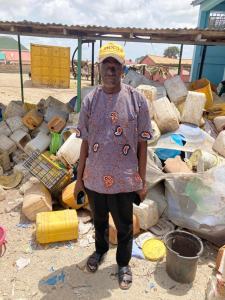 Jim can already see what could come next. With more equipment and suitable workspace, he believes the group could increase its productivity and create further employment. That is when the impact begins to multiply.
One person develops skills. A group becomes more productive. A small enterprise grows. More waste acquires a value. More people potentially earn an income. And a community develops more of the knowledge and infrastructure it needs to manage its own resources.
For Ebrima, it means dignity
There is another impact that is harder to measure. Waste collection can carry stigma. Ebrima Bah of the Seneya Group was aware of the negative perceptions associated with the work when he became involved. But he saw something different: an opportunity to earn an honest income while doing something useful for his community.
“This work allows me to support my family while helping keep my community clean.”
That sense of pride appears elsewhere in the participants’ words:
“I am proud that my work contributes to a cleaner environment.”
And:
“Waste has value, and it can improve people’s lives.”
Perhaps those words get closest to what WasteAid’s impact really means. Of course, we need the numbers. We need to know how much waste is collected, how many people are trained and whether the systems we help establish continue to work.
But behind every number is a person.
A parent who can buy school materials. A household with a little more money when an emergency comes. A waste collector proud of the contribution they make. A community where less plastic is burned or dumped. An individual who has gained the skills and confidence to imagine turning waste collection into a growing business. That is the human impact of WasteAid’s work.
We don’t simply see waste as something that needs to disappear.
We see what can happen when people are given the knowledge, tools and opportunity to turn it into something valuable: cleaner communities, stronger livelihoods, greater dignity and a better future built locally.

News
Beyond the Numbers: The Human Impact of WasteAid’s Work
Members of WasteAid’s Gambia team, Lamin Janneh and Jojo Saho, recently investigated what our programmes mean to our individual participants by speaking to members...
News
Journey to Uganda: Stories from our projects
Recently, the Programme Management team travelled to Uganda to meet the people at the heart of our waste management programmes, connect with local stakeholders...
News
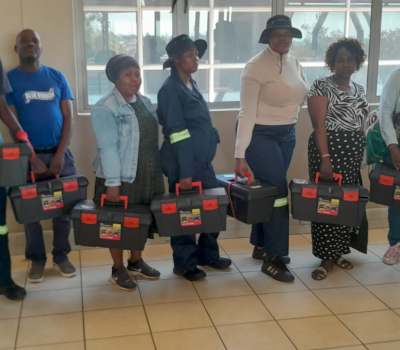
From E-Waste Skills to Sustainable Enterprise: Cosmo City Participants Take the Next Step
What if a broken laptop, television or other electronic appliance wasn’t waste, but an opportunity to repair, reuse and recycle? For participants in WasteAid’s Waste 2...
News
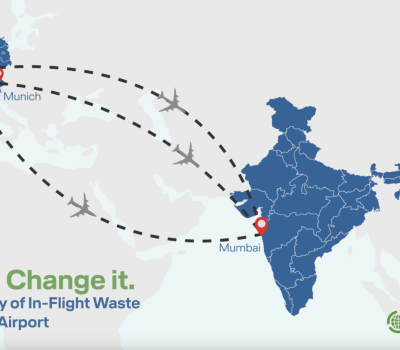
Lufthansa Group and WasteAid Launch Animation Film
WasteAid and Lufthansa Group have launched a new animated training film designed to help cabin crew improve onboard waste segregation, supporting efforts to increase...
News
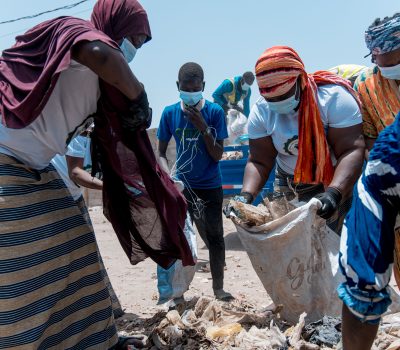
How one community in The Gambia is changing its relationship with plastic
In Bakoteh, a community in the Greater Banjul Area of The Gambia, plastic waste has long been a serious problem. Home to the largest dumpsite in...
News
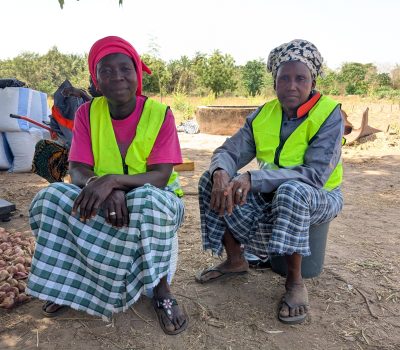
Women farmers in Kalaji turn organic waste into opportunity through the S-ORGANIC project
In Kalaji, a group of women farmers is demonstrating how organic waste can become a productive resource — supporting sustainable agriculture, strengthening livelihoods, and...
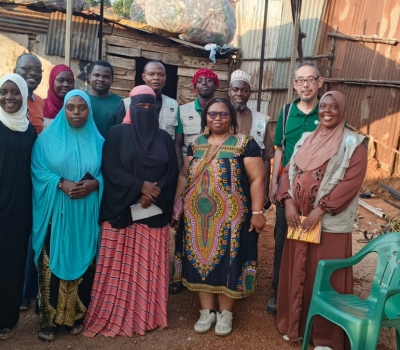
Recently, the Programme Management team travelled to Uganda to meet the people at the heart of our waste management programmes, connect with local stakeholders and government donors, and see first-hand how our work is making an impact in communities.
What the team found was inspiring: people turning waste into livelihoods, communities taking ownership of the challenges they face, and women and young people using new skills and opportunities to build better futures for their families.
Being on the ground gave our team a much deeper understanding of what this support means in people’s everyday lives. We saw the impact of Bunzl’s support first-hand; from wastepreneurs growing their businesses and creating jobs, to communities coming together to take ownership of waste management challenges and create opportunities for others.
These experiences showed us that the impact of investing in waste management goes far beyond waste itself. It is about people, livelihoods, families and communities, and the lasting change that can happen when people have the right support and opportunities.
Supporting Uganda’s Wastepreneurs
At the heart of our work in Uganda are the people who are transforming waste into opportunity. Through the Wastepreneur programme, we are supporting waste workers to grow their businesses, strengthen their livelihoods and build a better future for their families.
To date, the Wastepreneur Challenge Programme in Kampala city has supported 27 waste workers which constitute of 9 waste pickers, 9 waste collectors and 9 recyclers. By providing training, mentorship and practical support, the Wastepreneur programme has enabled beneficiaries to support their waste management businesses and earn a livelihood.
How the Wastepreneur programme transformed Eva’s life
For more than 13 years, Eva has earned a living by buying recyclable materials from local waste collectors and selling them to larger recycling businesses.
Like many people working in the informal waste sector, Eva faced significant challenges. High transport costs, limited storage and unreliable weighing of recyclable materials made it difficult to grow her business.
Through the Wastepreneur programme, Eva received a motorbike, storage space, a digital scale and Personal Protective Equipment (PPE) which transformed her life.
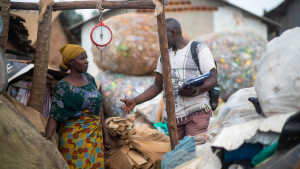
The motorbike made a significant impact in her business as it enabled her to collect much larger quantities of recyclable material from local waste collectors. As her business grew, so did her ability to create employment opportunities for others.
She has now employed four permanent workers to assist her with her expanded business and is also working with part-time waste pickers creating employment for many in the community.
Further, through her earnings, Eva has been able to pay for her children’s education and support her son through university. He has now graduated and is helping his mother with her waste management business.
Eva’s story shows the impact of the Wastepreneur programme towards building sustainable livelihoods. Her success has not only empowered her family but has also created jobs within the community.
The impact of the HUBLINK project in Kampala
In Mugema Zone of Kampala city, waste is a highly visible challenge. Where there was once a dumping site, a small group of residents saw an opportunity to create something different: a community-run waste aggregation hub that could help keep the neighbourhood clean while creating livelihoods.
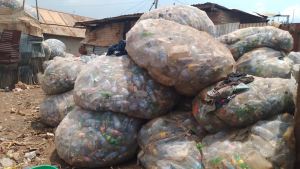
The hub initially began with around eight founding members, but has now grown into a cooperative with 35 members and 140 waste collectors supplying materials to the hub. Many households in the area also bring items to sell to the hub, and members also take initiative to raise awareness of waste management in the community. Further, the hub also has smaller collection points within the community to assist with waste collection.
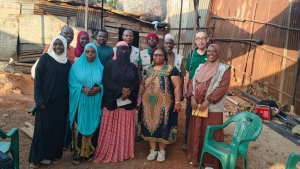
‘’The visit to the hub gave me a much deeper appreciation of what the community has built and the potential for the project to create even greater impact. What struck me most was the sense of ownership. This is a community addressing a problem that affects them every day, and doing so in a way that creates economic opportunities for local people.’’ – Cleo, Programmes Manager at WasteAid
To date, the hub is handling around 35 tonnes of plastic waste every month, proceeds of which are also used to feed orphans and the vulnerable in the community.
Communities leading the way
From Eva’s growing business to the community-run hub in Mugema Zone, people are demonstrating that waste can be a source of opportunity and that investing in waste workers and community-led waste management solutions can create benefits that ripple far beyond waste itself.
Help us create more opportunities through waste
With the right support, more waste workers can build safer, more sustainable livelihoods, more communities can develop effective waste management systems, and more families can benefit from the opportunities created.
Support our Wastepreneur programme today and help us create more stories of opportunity, dignity and lasting change.
News
Beyond the Numbers: The Human Impact of WasteAid’s Work
Members of WasteAid’s Gambia team, Lamin Janneh and Jojo Saho, recently investigated what our programmes mean to our individual participants by speaking to members...
News
Journey to Uganda: Stories from our projects
Recently, the Programme Management team travelled to Uganda to meet the people at the heart of our waste management programmes, connect with local stakeholders...
News
From E-Waste Skills to Sustainable Enterprise: Cosmo City Participants Take the Next Step
What if a broken laptop, television or other electronic appliance wasn’t waste, but an opportunity to repair, reuse and recycle? For participants in WasteAid’s Waste 2...
News
Lufthansa Group and WasteAid Launch Animation Film
WasteAid and Lufthansa Group have launched a new animated training film designed to help cabin crew improve onboard waste segregation, supporting efforts to increase...
News
How one community in The Gambia is changing its relationship with plastic
In Bakoteh, a community in the Greater Banjul Area of The Gambia, plastic waste has long been a serious problem. Home to the largest dumpsite in...
News
Women farmers in Kalaji turn organic waste into opportunity through the S-ORGANIC project
In Kalaji, a group of women farmers is demonstrating how organic waste can become a productive resource — supporting sustainable agriculture, strengthening livelihoods, and...
What if a broken laptop, television or other electronic appliance wasn’t waste, but an opportunity to repair, reuse and recycle?
For participants in WasteAid’s Waste 2 Wealth, Cosmo City E-Wastepreneur programme in Uganda, practical training is helping turn that idea into a potential livelihood.
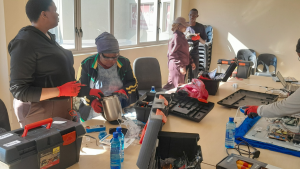
Over recent months, participants have moved from classroom learning into hands-on training in e-waste repair, diagnostics and enterprise development. They have learned how to safely use professional tools, identify faults and assess whether discarded electrical items can be repaired, refurbished or recovered.
For participants, the impact goes beyond learning how to fix appliances. They are developing the technical skills, confidence and problem-solving abilities needed to create sustainable livelihoods within the circular economy. Moreover, it also benefits the communities and environment as it reduces disposal of electronic appliances and enables further use of them.
“Before this training I thought a broken kettle was simply useless, but now I know how to test it and find where the real problem is.” – Boitumelo Khoetha, E-Wastepreneur Participant
Understanding the e-waste sector beyond repairing
In July, 10 participants visited Reclite SA, gaining first-hand experience of how a formal e-waste business operates.
The study tour gave participants a broader understanding of the e-waste value chain, from collection and repair through to recycling and material recovery, as well as the importance of health and safety and effective business management.
Crucially, they were also able to identify potential markets and buyers for recovered materials, helping them see how their own enterprises could connect to the wider circular economy.
“Seeing the systematic processes, safety measures, and how every material has value has completely changed my perspective. I now understand how I can improve my own business.” – Tumo Shivambo, E-Wastepreneur Participant
From training to enterprise
At the end of July, participants completed their practical assessments, marking an important milestone in their training.
But this is not the end of the programme.
Each participant will now receive four individual mentorship sessions, combining technical and business support to help turn their newly developed skills into viable enterprise ideas.
The programme will culminate in a Business Pitching Event in September, where participants will present their ideas and showcase how they plan to turn e-waste into opportunity. Participants will also get the opportunity to access resources, tools and equipment to enable their business growth and application of learned principles.
Through Waste 2 Wealth, WasteAid is helping people move from seeing e-waste as a problem to recognising its potential, while building the skills, knowledge and confidence needed to create livelihoods while keeping valuable materials in use.
From discarded electronics to sustainable enterprise, the next chapter is just beginning.
News
Beyond the Numbers: The Human Impact of WasteAid’s Work
Members of WasteAid’s Gambia team, Lamin Janneh and Jojo Saho, recently investigated what our programmes mean to our individual participants by speaking to members...
News
Journey to Uganda: Stories from our projects
Recently, the Programme Management team travelled to Uganda to meet the people at the heart of our waste management programmes, connect with local stakeholders...
News
From E-Waste Skills to Sustainable Enterprise: Cosmo City Participants Take the Next Step
What if a broken laptop, television or other electronic appliance wasn’t waste, but an opportunity to repair, reuse and recycle? For participants in WasteAid’s Waste 2...
News
Lufthansa Group and WasteAid Launch Animation Film
WasteAid and Lufthansa Group have launched a new animated training film designed to help cabin crew improve onboard waste segregation, supporting efforts to increase...
News
How one community in The Gambia is changing its relationship with plastic
In Bakoteh, a community in the Greater Banjul Area of The Gambia, plastic waste has long been a serious problem. Home to the largest dumpsite in...
News
Women farmers in Kalaji turn organic waste into opportunity through the S-ORGANIC project
In Kalaji, a group of women farmers is demonstrating how organic waste can become a productive resource — supporting sustainable agriculture, strengthening livelihoods, and...
The short animation forms part of the ongoing collaboration between WasteAid and Lufthansa Group to reduce the amount of airline waste ending up in landfill. Developed as part of the Circular Economy Project at the Lufthansa Group Mumbai outstation, the film encourages cabin crew to segregate recyclable materials during flights, helping preserve the quality and value of materials before they enter the airport waste management system.
The animation was developed following a detailed assessment of waste management practices for Lufthansa and SWISS flights arriving at the Mumbai outstation. Waste flow mapping and waste audits revealed that while some waste is segregated during cabin service and stored in tray-equipped trolley carts, many recyclable and perishable items are stored together as mixed waste. As a result, liquids, moisture and food residues from waste often contaminate otherwise recyclable materials, reducing their quality and limiting their potential for recycling.
The film brings this challenge to life by following the journey of a paper box after it leaves the aircraft. It illustrates the downstream waste management process, from collection and sorting to recycling, showing how proper onboard segregation helps keep valuable materials in circulation. By highlighting the people and processes involved in recovering onboard waste, the animation also demonstrates how better segregation can improve working conditions for waste workers who manually sort waste after it is unloaded from the aircraft.
Designed as a concise and engaging learning tool, the animation can be easily integrated into existing crew communications and training. Rather than introducing new procedures, it reinforces best practices and demonstrates how small actions during routine cabin service can collectively make a significant environmental impact.
WasteAid worked closely with Lufthansa Group, airline catering partners, airport stakeholders, and local waste management organisations throughout the project to ensure the film reflects operational realities while promoting practical improvements that can be seamlessly incorporated into everyday flight operations.
The animation forms part of WasteAid’s wider Circular Economy Project with Lufthansa Group in India, which aims to improve resource recovery from airline waste through better onboard segregation, strengthened recycling systems, and collaboration across the entire waste value chain. Together, these initiatives help divert valuable materials from landfill, strengthen local recycling systems, improve working conditions for waste workers, and keep resources in circulation for longer.
News
Beyond the Numbers: The Human Impact of WasteAid’s Work
Members of WasteAid’s Gambia team, Lamin Janneh and Jojo Saho, recently investigated what our programmes mean to our individual participants by speaking to members...
News
Journey to Uganda: Stories from our projects
Recently, the Programme Management team travelled to Uganda to meet the people at the heart of our waste management programmes, connect with local stakeholders...
News
From E-Waste Skills to Sustainable Enterprise: Cosmo City Participants Take the Next Step
What if a broken laptop, television or other electronic appliance wasn’t waste, but an opportunity to repair, reuse and recycle? For participants in WasteAid’s Waste 2...
News
Lufthansa Group and WasteAid Launch Animation Film
WasteAid and Lufthansa Group have launched a new animated training film designed to help cabin crew improve onboard waste segregation, supporting efforts to increase...
News
How one community in The Gambia is changing its relationship with plastic
In Bakoteh, a community in the Greater Banjul Area of The Gambia, plastic waste has long been a serious problem. Home to the largest dumpsite in...
News
Women farmers in Kalaji turn organic waste into opportunity through the S-ORGANIC project
In Kalaji, a group of women farmers is demonstrating how organic waste can become a productive resource — supporting sustainable agriculture, strengthening livelihoods, and...
In Bakoteh, a community in the Greater Banjul Area of The Gambia, plastic waste has long been a serious problem. Home to the largest dumpsite in the region, residents have lived with the smoke from burning waste and the health risks that come with it – for years, there seemed to be no alternative.
That’s starting to change.
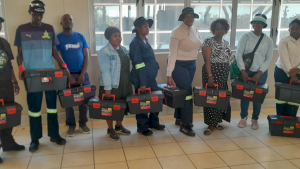
In September 2025, the Sobeya Kafo Waste Collectors Group was formed – ten local people who came together through WasteAid’s First Step Resource Management Programme, funded by Veralto. Over eight weeks, the group received training in everything from sorting and handling plastic safely, to running a small business and managing finances. The goal: to help the community build its own sustainable waste management system from the ground up.
The results are already visible. At a recent community event, the shift in how people think about plastic was striking. Where once it was something to throw away or burn, people are now seeing it differently – as something with real environmental and economic value.
Absa Joof, the group’s Secretary, put it simply:
“This project has been an eye opener for me. Before, my household and I used to burn plastic waste or dispose of it carelessly. After participating in WasteAid’s training, I now see opportunities to generate income from waste.”
What stood out just as much as the training itself was who showed up. Young people were actively involved throughout – in the workshops, and in the community clean-up, known locally as Sett-Setal. That kind of grassroots energy is exactly what long-term change looks like.
This is what WasteAid’s work is about: not just cleaner streets, but stronger communities. When people have the knowledge and tools to manage waste themselves, the benefits go far beyond the environment – they create livelihoods, build confidence, and give communities real ownership over their futures.
Thank you to Veralto for your support, without which this programme would not be made possible.
News
Beyond the Numbers: The Human Impact of WasteAid’s Work
Members of WasteAid’s Gambia team, Lamin Janneh and Jojo Saho, recently investigated what our programmes mean to our individual participants by speaking to members...
News
Journey to Uganda: Stories from our projects
Recently, the Programme Management team travelled to Uganda to meet the people at the heart of our waste management programmes, connect with local stakeholders...
News
From E-Waste Skills to Sustainable Enterprise: Cosmo City Participants Take the Next Step
What if a broken laptop, television or other electronic appliance wasn’t waste, but an opportunity to repair, reuse and recycle? For participants in WasteAid’s Waste 2...
News
Lufthansa Group and WasteAid Launch Animation Film
WasteAid and Lufthansa Group have launched a new animated training film designed to help cabin crew improve onboard waste segregation, supporting efforts to increase...
News
How one community in The Gambia is changing its relationship with plastic
In Bakoteh, a community in the Greater Banjul Area of The Gambia, plastic waste has long been a serious problem. Home to the largest dumpsite in...
News
Women farmers in Kalaji turn organic waste into opportunity through the S-ORGANIC project
In Kalaji, a group of women farmers is demonstrating how organic waste can become a productive resource — supporting sustainable agriculture, strengthening livelihoods, and...
In Kalaji, a group of women farmers is demonstrating how organic waste can become a productive resource — supporting sustainable agriculture, strengthening livelihoods, and contributing to a local circular economy.
During a recent monitoring visit, WasteAid’s Director of Programmes, Akira Akazawa, joined the WasteAid Gambia team to meet one of the farmer groups supported by the EU-funded S-ORGANIC project — Scaling up Organic Fertilisers in The Gambia: Advancing Nutrition, Innovations and Circular Economy.
The team met a well-established group of around 75 members, the majority of whom are women. Drawing on training and practical support provided through the project, the group has been producing organic compost and fertiliser using locally available materials — putting new skills and knowledge to work in their own community.
Their efforts directly address one of S-ORGANIC’s core aims: reducing reliance on imported chemical fertilisers by building local capacity to produce and use organic alternatives. The project also works to improve soil fertility, promote more sustainable food production, and support the productive use of organic waste.
During the visit, group members described how they produce compost for use in vegetable and crop cultivation, including rice and maize. They also shared why organic compost is increasingly valued — noting that crops grown with organic inputs can stay fresh for longer, an important quality for both farmers and customers.
The group currently produces an estimated 100 bags of compost per month. But members were clear about what is needed to grow sustainably: more reliable access to raw materials, lower input costs, greater consistency in product quality, and stronger links to markets.
Speaking after the visit, Akira Akazawa said:
“The Kalaji women farmer group is a strong example of what the S-ORGANIC project is working to achieve. Their work connects environmental management, sustainable agriculture, and women’s economic empowerment in a very practical way. The next step is to support them to strengthen quality, improve access to materials, and build reliable markets for their compost.”
The visit reinforced the importance of combining technical training with business and market development support. WasteAid and partners will continue working with the group to strengthen production records, improve compost quality, review raw material supply chains, and identify potential buyers.
The Kalaji site also has real potential to become a learning resource for other communities exploring organic compost production and circular economy approaches.
Through S-ORGANIC, WasteAid is working with partners to advance practical, locally led solutions that turn waste into value, support sustainable agriculture, and contribute to food security across The Gambia.
News
Beyond the Numbers: The Human Impact of WasteAid’s Work
Members of WasteAid’s Gambia team, Lamin Janneh and Jojo Saho, recently investigated what our programmes mean to our individual participants by speaking to members...
News
Journey to Uganda: Stories from our projects
Recently, the Programme Management team travelled to Uganda to meet the people at the heart of our waste management programmes, connect with local stakeholders...
News
From E-Waste Skills to Sustainable Enterprise: Cosmo City Participants Take the Next Step
What if a broken laptop, television or other electronic appliance wasn’t waste, but an opportunity to repair, reuse and recycle? For participants in WasteAid’s Waste 2...
News
Lufthansa Group and WasteAid Launch Animation Film
WasteAid and Lufthansa Group have launched a new animated training film designed to help cabin crew improve onboard waste segregation, supporting efforts to increase...
News
How one community in The Gambia is changing its relationship with plastic
In Bakoteh, a community in the Greater Banjul Area of The Gambia, plastic waste has long been a serious problem. Home to the largest dumpsite in...
News
Women farmers in Kalaji turn organic waste into opportunity through the S-ORGANIC project
In Kalaji, a group of women farmers is demonstrating how organic waste can become a productive resource — supporting sustainable agriculture, strengthening livelihoods, and...