News
Beyond the Numbers: The Human Impact of WasteAid’s Work
Members of WasteAid’s Gambia team, Lamin Janneh and Jojo Saho, recently investigated what our programmes mean to our individual participants by speaking to members...

On 26 April 2022, international NGO WasteAid hosted a celebratory event at the HTA School of Culinary Art in Randburg, bringing together entrepreneurs and industry leaders from the across the city at an event branded “Making the Circular Economy a Reality in Johannesburg”.
The event was the culmination of a two-year programme to support innovators and business start-ups that help keep “wasted” resources in the loop, creating a cleaner city and sustainable livelihood opportunities. The Circular Economy Network programme, run by WasteAid, aimed to fast-track local solutions to a circular economy in Johannesburg.
A wide variety of stakeholders attended the event including representatives from the Foreign and Commonwealth Development Office, Business Finland, Tourvest, packaging recovery organisation Plastics SA and programme sponsor Huhtamaki, a global supplier of packaging solutions. Juan Mulder, OpEx Manager at Huhtamaki, was full of praise for the entrepreneurs, saying, “This was a fantastic event, and we need more like them!”
 Launching the proceedings, Mr Mulder thanks WasteAid for bringing local innovators, entrepreneurs and circular economy business leaders together, and shared insights into Huhtamaki’s commitments to sustainability across the supply chain.
Michelle Wilson, Circular Economy Network Director at WasteAid then shared the achievements of the initiative, with 36 companies given business incubator support and 60,000 Euros of seed funding to expand their businesses. Ms Wilson comments, ““It was great to see so many entrepreneurs and innovators making connection here today! It was truly the Circular Economy Network in action”.
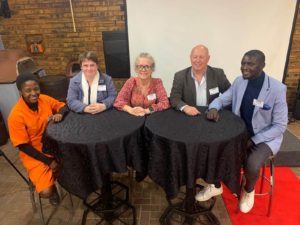
Panel discussion: L-R Nondumiso Sibiya (Boombadotmobi), Ceris Turner-Bailes (CEO WasteAid), Michelle Wilson (Circular Economy Network Director, WasteAid), Douw Steyn (Plastics SA), Sbusiso Shongwe (Boombadotmobi)
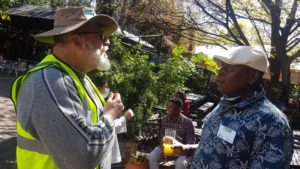
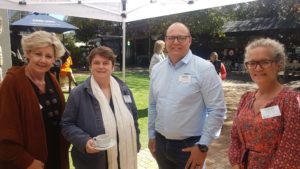
Left: Claudio BuffaPace – Community Bin Project & Advocate Zweli Sono of WCCA (Windsor Community Cleaning Association) Right: Gail Styger (The Wot-If Trust), Ceris Turner-Bailes (WasteAid), Juan Mulder (Huhtamaki), Michelle Wilson (WasteAid)
Angela Ludek, Project Officer for Informal Sector Engagement at WasteAid, led a spotlight session on seven of the semi-finalists of WasteAid’s Zero Waste Cities challenge.
Boombadotmobi, who work in Diepsloot one of Johannesburg’s biggest townships to eradicate illegal dumping, were one of 2 winners of the competition. They described the impact of winning the competition on their business; “Before we relied on a business model where 75% of the income went to the transporter but now we have swapped it around through the purchase of a truck”. Thanks to the Zero Waste Cities Challenge prize money, Boombadotmobi are now able to save and invest more of their earnings into developing their business.
Makhabisi Recycling and Trade, an all-female recycling outfit described the challenges they still face. Their buy-back centre, housed in a disused steel factory is without direct power which makes it difficult to operate their bailers/compactors to capacity. Life in the waste value chain is still very much hand to mouth with very little regulation of pricing of plastics which leaves waste collectors and aggregators very exposed to income fluctuations.
With many parts of Johannesburg still underserved with waste collections and recycling, these grassroots entrepreneurs are providing a much-needed value to society.
Following the spotlight session, a panel event was held with Douw Steyn from Plastics SA, Ceris Turner Bailes CEO of WasteAid and Sbusiso Shongwe and Nondumiso Sibiya from Boombadotmobi to explore the question “What is needed to support waste entrepreneurs?” Some of the key points raised included:
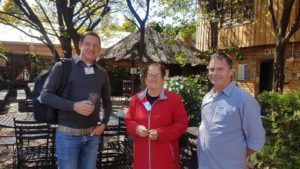
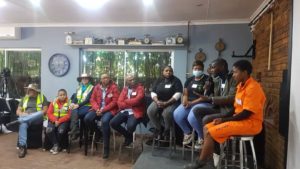
Left: Marc Myers (Tourvest), Winnie McHenry and Mark Fruhauf (Upcycle) Right: Circular Economy Network members in Johannesburg on stage – Claudio BuffaPace, Thapelo Thabokgane, Antoinette Botha (Community Bin); Nokuthula Nkosi and Mandkenkosi Nkosi (Man Recycling); Harriet Matjila and Jaqueline Hartebeest (Makhabisi Recycling); Sbusiso Shongwe and Nondumiso Sibiya (Boombadotmobi)
Following the panel discussion, four innovators presented their businesses including Winnie McHenry from Upcycle, who challenged the view that upcycling had to be a small cottage industry. She described how she was able to fulfil an order from a corporate client for 3,000 glasses made of disused bottles through a dedicated network of producers. Ms McHenry’s aim is to build on existing skills in the community (such as crocheting and knitting) and to swap traditional materials for plastics that would otherwise become a waste.
The whole event was designed with circularity in mind. Branded gift bags were made by Upcycle, a local Circular Economy Network member that works across South Africa to build the skills of unemployed youth with products made from unwanted waste material. They also provided pens and notepads that were rejects from corporate branding exercises, that would have ended up in a landfill.
An exhibition gave the local innovators chance to promote their solutions, including Community Bin, Upcycle, Makhabisi and Bokashi Bran. The zero waste lunch was provided by Nosh Food Rescue and prepared by Celebrity Chef Citrum Thembinkosi Khumalo. Nosh Food Rescue regularly feeds hundreds of meals to the local community with delicious and nutritious food that otherwise would have ended up at landfill.
Written by Zoë Lenkiewicz
NOTES TO EDITORS
About WasteAid
Contact:
Rose Bradbury
Senior Fundraising & Communications Officer, WasteAid

News
Beyond the Numbers: The Human Impact of WasteAid’s Work
Members of WasteAid’s Gambia team, Lamin Janneh and Jojo Saho, recently investigated what our programmes mean to our individual participants by speaking to members...
News
Journey to Uganda: Stories from our projects
Recently, the Programme Management team travelled to Uganda to meet the people at the heart of our waste management programmes, connect with local stakeholders...
News
From E-Waste Skills to Sustainable Enterprise: Cosmo City Participants Take the Next Step
What if a broken laptop, television or other electronic appliance wasn’t waste, but an opportunity to repair, reuse and recycle? For participants in WasteAid’s Waste 2...
News
Lufthansa Group and WasteAid Launch Animation Film
WasteAid and Lufthansa Group have launched a new animated training film designed to help cabin crew improve onboard waste segregation, supporting efforts to increase...
News
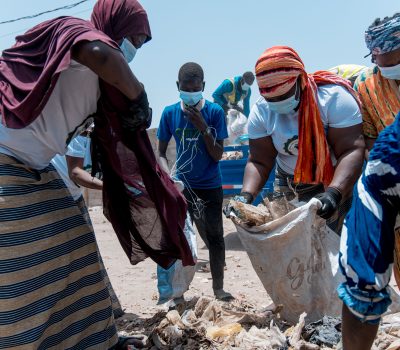
How one community in The Gambia is changing its relationship with plastic
In Bakoteh, a community in the Greater Banjul Area of The Gambia, plastic waste has long been a serious problem. Home to the largest dumpsite in...
News
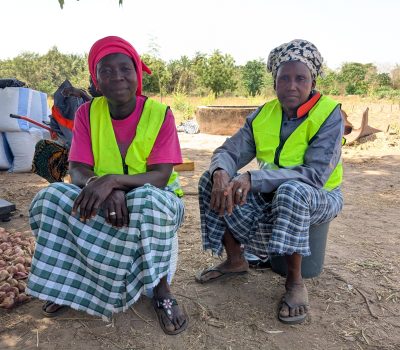
Women farmers in Kalaji turn organic waste into opportunity through the S-ORGANIC project
In Kalaji, a group of women farmers is demonstrating how organic waste can become a productive resource — supporting sustainable agriculture, strengthening livelihoods, and...
WasteAid is launching two more initiatives to prevent plastic pollution in Cameroon and South Africa, with support from long-term funding partner Bunzl plc.
In Cameroon, the funding will see WasteAid continue to build waste management and plastic recycling capacity in the coastal city of Douala. Building on a previous project also funded by Bunzl plc, and with cooperation from the municipal council, WasteAid will recruit and train 30 unemployed youth to work in the plastic waste value chain, maximising the value recoverable from plastic collected from the city.
WasteAid will also run a multimedia communications campaign to engage citizens in the fight against plastic pollution, raise awareness of the problems caused by litter, and encourage people to separate their plastics for recycling.
In South Africa, WasteAid will be providing technical support and microgrants to waste picker groups in Johannesburg. This follows on from WasteAid’s Zero Waste Cities Challenge in 2021, which identified the specific needs of these groups to strengthen and grow their businesses and recover more value from waste materials.
Working with local associations, WasteAid will provide tailored training in business skills for up to 50 waste pickers to enable them to increase their earning potential. The training will be followed by the opportunity to pitch for microgrants to support their activities, for example for the purchase of handcarts or compactors, or rental of a premises for aggregating material.
James Pitcher, Head of Sustainability for Bunzl plc commented: “WasteAid’s projects help communities in lower-income countries set up waste collection and recycling services that protect the environment and provide livelihood opportunities. We are delighted to be supporting WasteAid as it continues its work in Cameroon, while giving grassroots initiatives in South Africa the support they need to grow.”
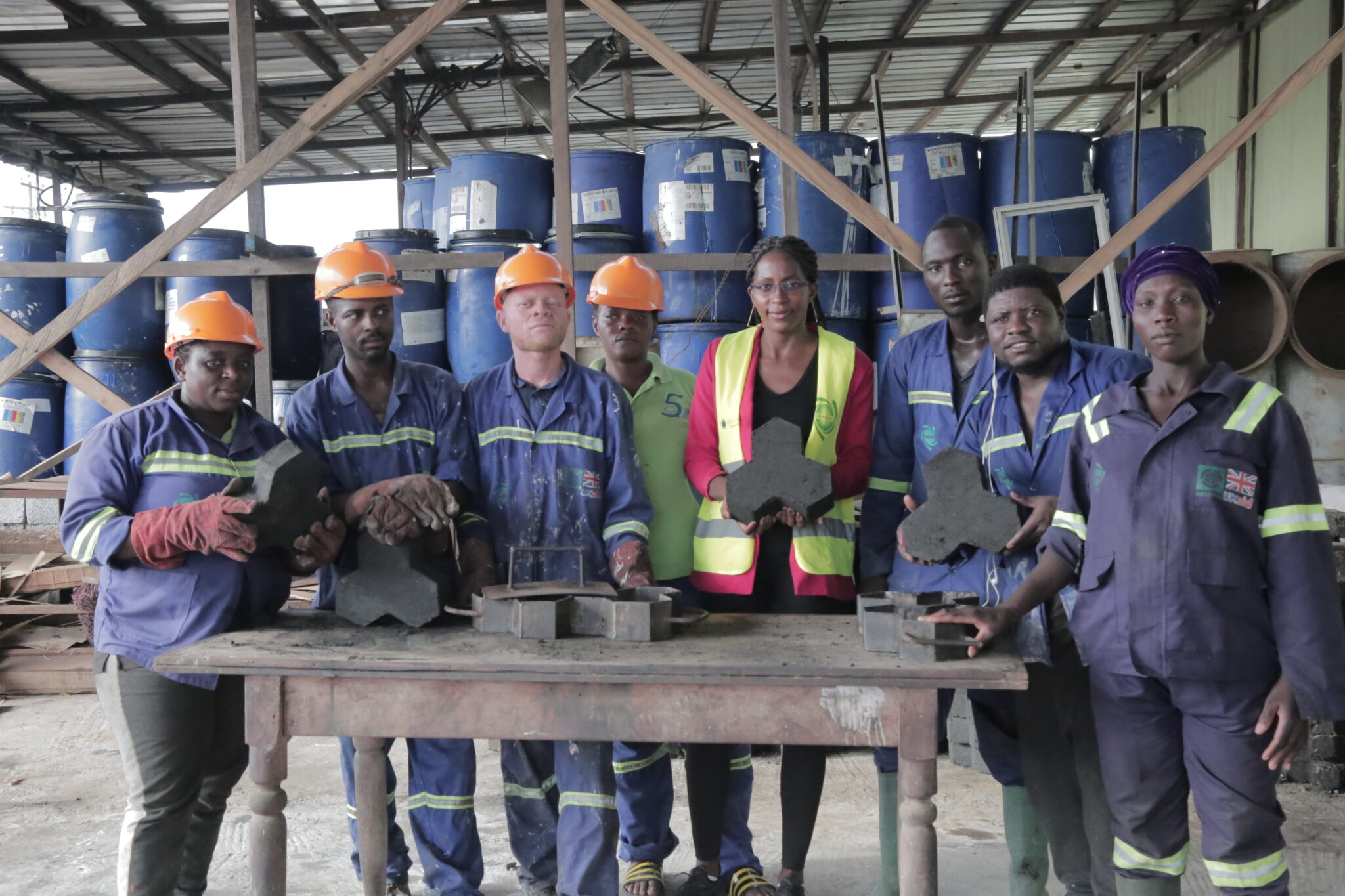
Over the last two years, with funding from Bunzl, WasteAid has provided infrastructure, training and employment to support livelihoods in recycling in Indonesia and Cameroon.
WasteAid CEO Ceris Turner-Bailes said: “We are extremely grateful to Bunzl plc for continuing its support for waste collection and recycling initiatives in the communities where WasteAid works. Pollution from poorly managed waste affects all of us, whether through health impacts, marine plastic pollution or climate change. This ongoing partnership means more people can benefit from being part of a circular economy, with all the long-term benefits this brings.”

In places with no waste collection service, plastic blocks drains which makes flooding worse for affected communities, and provides breeding grounds for mosquitoes, contributing to the spread of disease. Plastic waste that enters waterways eventually reaches the ocean, impacting marine wildlife and entering food chains. People often burn their waste to avoid the problems of litter, but this releases harmful emissions and contributes to climate change.
WasteAid is committed to supporting communities in setting up and maintaining waste collection and recycling programmes that can provide jobs, while keeping the environment free from litter. Waste management offers an affordable way for lower-income communities to improve livelihoods, and for countries to deliver the United Nations Sustainable Development Goals and their Nationally Determined Contributions for climate emissions abatement.
Written by Zoë Lenkiewicz
NOTES TO EDITORS
About WasteAid
About Bunzl plc
Contact:
Rose Bradbury
Senior Fundraising & Communications Officer, WasteAid
News
Beyond the Numbers: The Human Impact of WasteAid’s Work
Members of WasteAid’s Gambia team, Lamin Janneh and Jojo Saho, recently investigated what our programmes mean to our individual participants by speaking to members...
News
Journey to Uganda: Stories from our projects
Recently, the Programme Management team travelled to Uganda to meet the people at the heart of our waste management programmes, connect with local stakeholders...
News
From E-Waste Skills to Sustainable Enterprise: Cosmo City Participants Take the Next Step
What if a broken laptop, television or other electronic appliance wasn’t waste, but an opportunity to repair, reuse and recycle? For participants in WasteAid’s Waste 2...
News
Lufthansa Group and WasteAid Launch Animation Film
WasteAid and Lufthansa Group have launched a new animated training film designed to help cabin crew improve onboard waste segregation, supporting efforts to increase...
News
How one community in The Gambia is changing its relationship with plastic
In Bakoteh, a community in the Greater Banjul Area of The Gambia, plastic waste has long been a serious problem. Home to the largest dumpsite in...
News
Women farmers in Kalaji turn organic waste into opportunity through the S-ORGANIC project
In Kalaji, a group of women farmers is demonstrating how organic waste can become a productive resource — supporting sustainable agriculture, strengthening livelihoods, and...
On 14 January 2022, the British High Commission in Banjul hosted the launch of a new Circular Economy Network in The Gambia. Led by UK waste management NGO WasteAid, and funded by the UK’s Chartered Institution of Wastes Management, the Circular Economy Network will help improve the way resources and wastes are managed in The Gambia, preventing pollution and supporting livelihoods in a green economy.
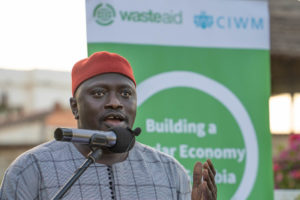 At the launch event, H.E. Lamin Dibba, Minister of Environment, Natural Resources and Climate Change introduced the initiative, saying:
“This Circular Economy Network will support our national green recovery initiative, protect natural resources and prevent climate emissions. Importantly, it will raise the profile of sustainable resource management and provide a platform for national stakeholders and waste managers in the UK to collaborate.”
Currently, resources are used in a linear fashion and soon become waste, which can pollute the ground, air and water courses and impact people’s health. By shifting to a more circular economy, valuable resources can be kept in use for longer, providing livelihood opportunities and enabling The Gambia to become more self-sufficient and resilient to climate change.
WasteAid will be sharing recycling knowledge and skills, training 30 vulnerable people to generate income from wastes, and supporting local innovation through seed funding and business support to a circular economy enterprise.
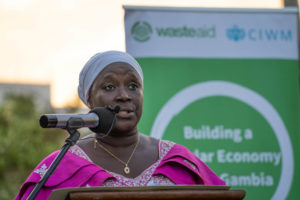 The launch event was also attended by Deputy Mayor Binta Janneh-Jallow of Kanifing Municipal Council, who said:
“An important facet of this new Circular Economy Network project will be support for Gambian innovation to reduce, reuse and recycle different waste materials. Recycling provides livelihood opportunities by turning waste into a resource and benefitting all aspects of society.”
The aim of this initiative is to establish a professional network of people and organisations in The Gambia who can support each other in the development of a circular economy, and is sustained after the project completes.
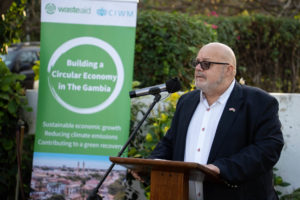 British High Commissioner David Belgrove has been very supportive of WasteAid and is well-aware of the need for improved waste management.
Mr Belgrove commented: “We were pleased to host the launch of this Circular Economy Network project led by WasteAid, which will add to the momentum that has already built up for a green recovery here in The Gambia. WasteAid and British waste management professionals will be sharing their experience and expertise with Gambian counterparts, further strengthening the ties between our two countries.”
Circular Economy Network members will be able to access training and take part in knowledge sharing sessions alongside experienced waste managers from the UK. Network activities will assist with regional and cross-sector cooperation, to help Government Ministries, Councils, businesses and community-based organisations work together to progress sustainable waste management in The Gambia.
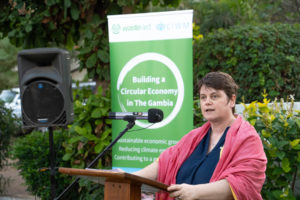 Ceris Turner-Bailes, CEO of WasteAid added: “WasteAid has been active in The Gambia since 2015 and the country remains at the heart of WasteAid’s work. The Gambia has some significant waste management challenges, but there are also ambitious policymakers, committed councils and an engaged civil society willing to deliver the change that is needed.
“That is why, when the Chartered Institution of Wastes Management expressed a desire to support our work, The Gambia was our top priority. We are looking forward to engaging with stakeholders in The Gambia and the UK on this unique initiative to support the development of a professional waste management sector and drive for a more circular economy.”
Adam Read, President of the UK’s Chartered Institution of Wastes Management, which is funding the Circular Economy Network in The Gambia said: “The Chartered Institution of Wastes Management (CIWM) is delighted to see this exciting partnership spring to life, and we look forward to playing an active role in delivering increasingly sustainable waste management practices in the Greater Banjul Area of The Gambia. The provision of funding for this large-scale delivery project demonstrates our continued commitment to advancing waste and resource management capability and enabling the transition to more circular economies across the globe.”
WasteAid welcomes all interested parties to join the Circular Economy Network, and will be promoting activities through a communications campaign. Please contact WasteAid’s Project Coordinator in The Gambia, via gambiaCEN@wasteaid.org.
Written by Zoë Lenkiewicz
News
Beyond the Numbers: The Human Impact of WasteAid’s Work
Members of WasteAid’s Gambia team, Lamin Janneh and Jojo Saho, recently investigated what our programmes mean to our individual participants by speaking to members...
News
Journey to Uganda: Stories from our projects
Recently, the Programme Management team travelled to Uganda to meet the people at the heart of our waste management programmes, connect with local stakeholders...
News
From E-Waste Skills to Sustainable Enterprise: Cosmo City Participants Take the Next Step
What if a broken laptop, television or other electronic appliance wasn’t waste, but an opportunity to repair, reuse and recycle? For participants in WasteAid’s Waste 2...
News
Lufthansa Group and WasteAid Launch Animation Film
WasteAid and Lufthansa Group have launched a new animated training film designed to help cabin crew improve onboard waste segregation, supporting efforts to increase...
News
How one community in The Gambia is changing its relationship with plastic
In Bakoteh, a community in the Greater Banjul Area of The Gambia, plastic waste has long been a serious problem. Home to the largest dumpsite in...
News
Women farmers in Kalaji turn organic waste into opportunity through the S-ORGANIC project
In Kalaji, a group of women farmers is demonstrating how organic waste can become a productive resource — supporting sustainable agriculture, strengthening livelihoods, and...
PRESS RELEASE

WasteAid, the international non-governmental organisation that shares waste management and recycling skills in lower- and middle-income countries, has entered into an 18-month funded partnership with materials science company Dow to advance plastic waste recovery and recycling in Egypt.
The partnership extends Dow’s global commitment to help advance a circular economy for plastics and reduce plastic waste and pollution in Africa. The project will see the organisations work with the public, private and community-level actors in Aswan, Egypt to support scalable and sustainable solutions for the collection and valorisation of post-consumer polyethylene (PE), which is used in a wide range of packaging applications, such as food packaging and household products.
Ceris Turner-Bailes, WasteAid CEO said: “A circular economy depends upon all parts of the value chain working in unison, from manufacturers and brands, to waste collectors and recyclers. We are delighted to be launching this partnership with Dow to uncover local solutions in Aswan to the recovery and recycling of plastic, with a particular focus on supporting informal waste collectors and recycling innovators who play a critical role in keeping materials in the loop.”
WasteAid will explore hotspots of plastic pollution, and then support local organisations and innovators to increase PE recovery and recycling. The project will leverage the expertise of both Dow and WasteAid to develop strong links with existing markets for post-consumer plastics.
Sami Mainich, President North Africa and Levant at Dow, commented: “We have a duty to help address the plastics waste challenge in Egypt and the wider African continent. To do this, we must advance circular solutions to fully close the loop on plastics waste. We can’t do this alone however, so collaborations across the value chain are critical to driving and scaling innovative technology and initiatives that benefit local communities. We are confident that this important partnership with WasteAid will help us to achieve our vision of a circular economy for plastics in Egypt and potentially, further afield.”
Adwoa Coleman, Africa Sustainability and Advocacy Manager, Packaging and Specialty Plastics at Dow, said: “Having been aware of WasteAid’s work for a number of years, we are excited to be launching this partnership as part of Project REFLEX in Africa – Dow’s programme designed to recycle flexible packaging. Dow has a strong global sustainability strategy and this work in Africa underpins our commitment to keeping valuable materials in the loop, to the benefit of all of society and the environment. We are looking forward to working with WasteAid on this novel approach to building a circular plastics economy in Egypt.”
In 2020, a Sky News documentary, The Plastic Nile, uncovered the scale of plastic litter in Africa’s greatest river from its source, to where it meets the Mediterranean Sea (1). Worldwide, 95% of plastic packaging material value is lost to the economy after a short first-use cycle, and 32% escapes collections systems (2). Through this project, WasteAid and Dow will be working with local partners to turn a pollution problem into an economic opportunity, and strengthening the market for post-consumer plastics in Egypt.
In addition to finding new uses for post-consumer plastic, the project will have a strong socio-economic focus, to maximise the benefits of a circular economy among grassroots groups in Aswan. The partnership seeks to demonstrate the importance of locally-crafted solutions in the drive for recycling, sustainability and a circular economy.
This partnership is enabled by the Dow Business Impact Fund, a competitive grant program that designates corporate contributions toward shared value projects to help address social problems through the Company’s technology and expertise.
For more information visit: https://corporate.dow.com/seek-together/shared-value-business-impact-fund
Written by Zoë Lenkiewicz
ENDS
Notes
(1) Plastic Nile: Pulling up plastic from the world’s longest river is horribly, frighteningly easy https://news.sky.com/story/plastic-nile-pulling-up-plastic-from-the-river-is-horribly-frighteningly-easy-11996674
(2) Ellen MacArthur Foundation, “The New Plastic Economy: Rethinking the future of plastics and catalysing action”, January 2016.
About WasteAid
WasteAid is a leading international development organisation on a mission to tackle the global waste crisis. 2 billion people do not have their waste collected and 3 billion lack a decent disposal site, leading to the spread of disease and polluting the air, land, rivers and oceans. WasteAid works with communities in low-income countries to address the root causes of poor health, climate change and marine plastic pollution.
WasteAid shares waste management knowledge and skills with governments and communities in low-income countries; trains people to become self-employed recycling entrepreneurs; and influences decision-makers and the donor community to increase investment in waste management. For more information, please visit www.wasteaid.org or follow @WasteAid on Twitter.
About Dow
Dow (NYSE: DOW) combines global breadth, asset integration and scale, focused innovation, and leading business positions to achieve profitable growth. The Company’s ambition is to become the most innovative, customer centric, inclusive, and sustainable materials science company. Dow’s portfolio of plastics, industrial intermediates, coatings, and silicones businesses delivers a broad range of differentiated science-based products and solutions for its customers in high-growth market segments, such as packaging, infrastructure, and consumer care. For more information, please visit www.dow.com or follow @DowNewsroom on Twitter.
Contact: Rose Bradbury, Senior Fundraising & Communications Officer, WasteAid. Email: media@wasteaid.org
News
Beyond the Numbers: The Human Impact of WasteAid’s Work
Members of WasteAid’s Gambia team, Lamin Janneh and Jojo Saho, recently investigated what our programmes mean to our individual participants by speaking to members...
News
Journey to Uganda: Stories from our projects
Recently, the Programme Management team travelled to Uganda to meet the people at the heart of our waste management programmes, connect with local stakeholders...
News
From E-Waste Skills to Sustainable Enterprise: Cosmo City Participants Take the Next Step
What if a broken laptop, television or other electronic appliance wasn’t waste, but an opportunity to repair, reuse and recycle? For participants in WasteAid’s Waste 2...
News
Lufthansa Group and WasteAid Launch Animation Film
WasteAid and Lufthansa Group have launched a new animated training film designed to help cabin crew improve onboard waste segregation, supporting efforts to increase...
News
How one community in The Gambia is changing its relationship with plastic
In Bakoteh, a community in the Greater Banjul Area of The Gambia, plastic waste has long been a serious problem. Home to the largest dumpsite in...
News
Women farmers in Kalaji turn organic waste into opportunity through the S-ORGANIC project
In Kalaji, a group of women farmers is demonstrating how organic waste can become a productive resource — supporting sustainable agriculture, strengthening livelihoods, and...
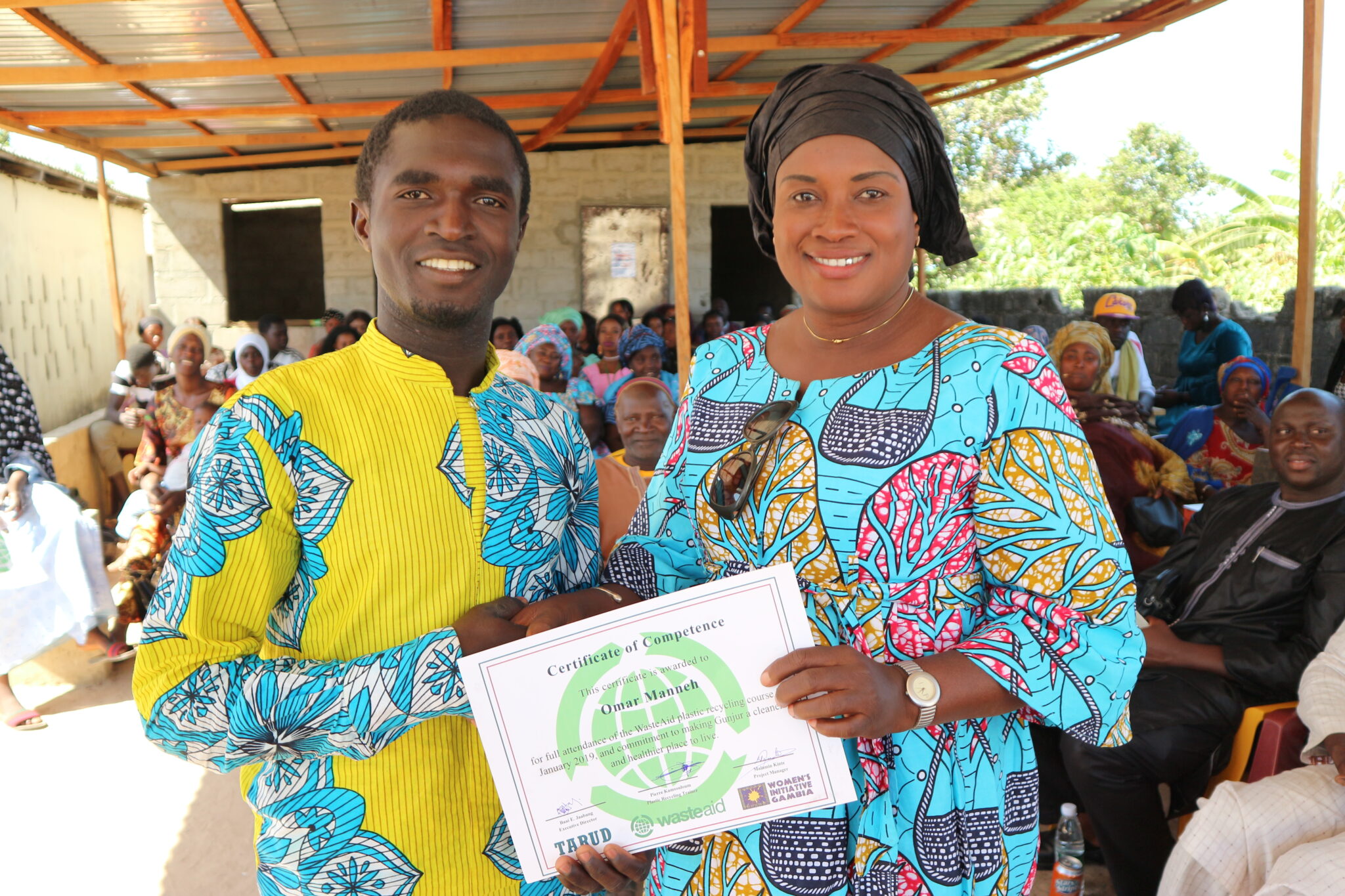
The Chartered Institution of Wastes Management (CIWM) has entered into an 18-month funded partnership with WasteAid, the international non-governmental organisation that shares waste management and recycling skills in lower- and middle-income countries, to support the development of waste management in the Greater Banjul Area (GBA) of The Gambia.
The GBA is home to 26% of The Gambian population, and a lack of comprehensive waste management systems is leading to significant health risks, marine plastic pollution and climate change emissions. The project will see WasteAid engage with a wide range of stakeholders to progress the delivery of sustainable waste management capacity, develop skills among the professional community and support the transition to a circular economy through education, training and investment.
Ceris Turner-Bailes, WasteAid CEO said: “We are sincerely grateful to CIWM for supporting WasteAid’s work in The Gambia. This project complements our previous recycling projects by helping develop a shared vision for sustainable resource management and a circular economy on a regional and national level. CIWM’s involvement means we can also leverage knowledge sharing and mentoring opportunities to drive best practice and promote professional standards in waste management.”
This partnership is the first of its kind for CIWM and will help deliver its strategic goals to advance waste and resource management capability and the transition to circular economies across the globe, and to respond to country-specific needs and ensure CIWM’s support for professionals is targeted and relevant.
Sarah Poulter, CIWM CEO said: “Sustainable waste management is a global social responsibility and a core element of the CIWM’s ambition to move to a world beyond waste. The decision to support WasteAid’s work in The Gambia is underpinned by the country’s genuine desire to better manage the waste it produces and develop a more circular economy. We’re excited about the positive impact this partnership will have on people’s lives and are committed to helping educate and inspire the local professional community. In doing so there is the opportunity to dramatically improve resource efficiency and create an environment where circular strategies can flourish.”
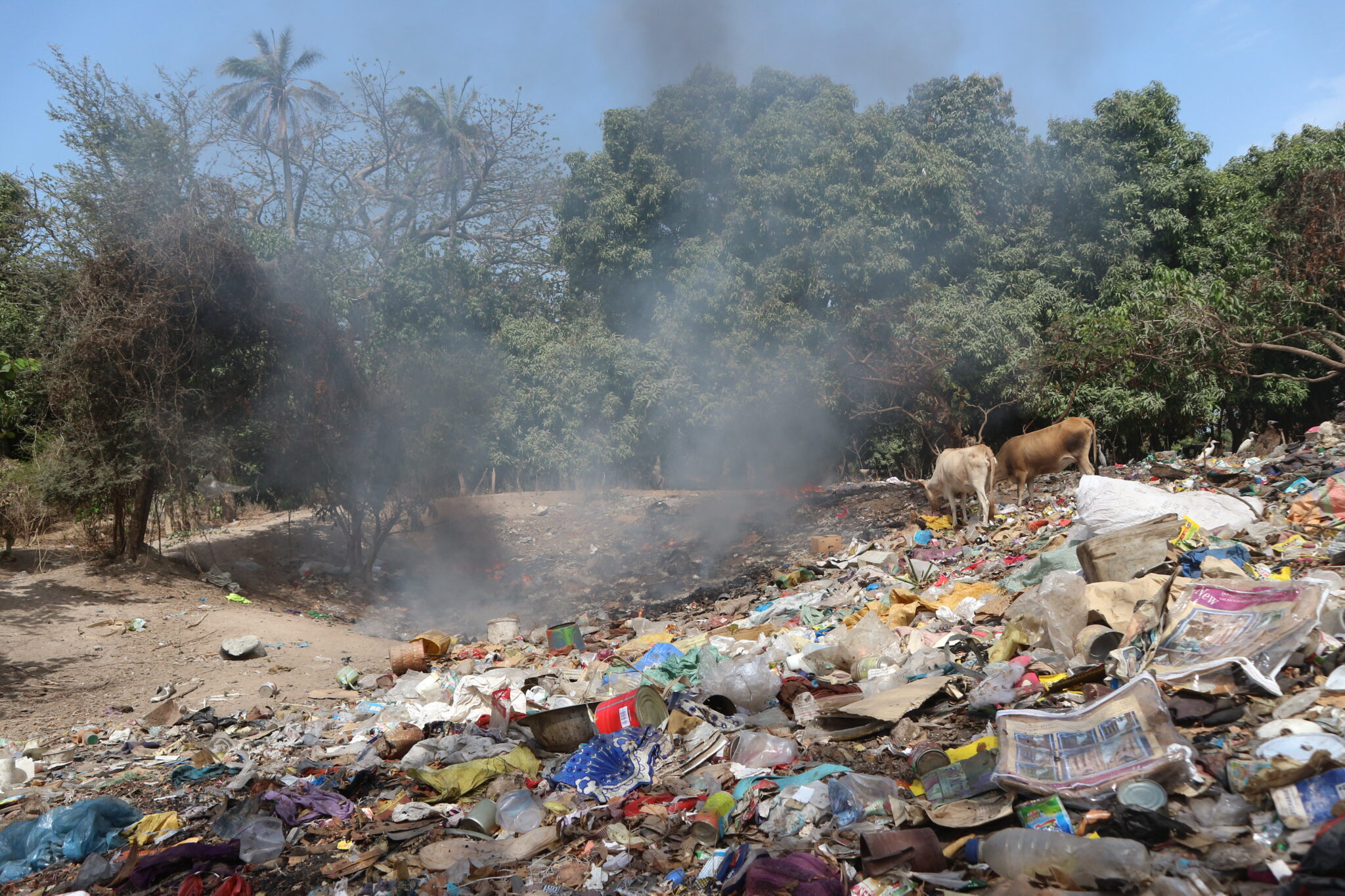
WasteAid has been working in The Gambia since 2015, and has built a strong network of government, private sector and community-based organisations with an interest in sustainable waste management. This project will see the formation of a circular economy network, the delivery of training and events, and a mentoring programme between CIWM members in the UK and Gambian members. WasteAid will also run a challenge for grassroots circular economy innovations, and develop a sustainable waste and recycling system that includes livelihood opportunities for 30 vulnerable people.
Written by Zoë Lenkiewicz
NOTES
About WasteAid
About CIWM
News
Beyond the Numbers: The Human Impact of WasteAid’s Work
Members of WasteAid’s Gambia team, Lamin Janneh and Jojo Saho, recently investigated what our programmes mean to our individual participants by speaking to members...
News
Journey to Uganda: Stories from our projects
Recently, the Programme Management team travelled to Uganda to meet the people at the heart of our waste management programmes, connect with local stakeholders...
News
From E-Waste Skills to Sustainable Enterprise: Cosmo City Participants Take the Next Step
What if a broken laptop, television or other electronic appliance wasn’t waste, but an opportunity to repair, reuse and recycle? For participants in WasteAid’s Waste 2...
News
Lufthansa Group and WasteAid Launch Animation Film
WasteAid and Lufthansa Group have launched a new animated training film designed to help cabin crew improve onboard waste segregation, supporting efforts to increase...
News
How one community in The Gambia is changing its relationship with plastic
In Bakoteh, a community in the Greater Banjul Area of The Gambia, plastic waste has long been a serious problem. Home to the largest dumpsite in...
News
Women farmers in Kalaji turn organic waste into opportunity through the S-ORGANIC project
In Kalaji, a group of women farmers is demonstrating how organic waste can become a productive resource — supporting sustainable agriculture, strengthening livelihoods, and...
The WasteAid Zero Waste Cities Challenge, taking place in Johannesburg, Ho Chi Minh City and Guwahati, has reached a climax with the announcement of the six winners. These grassroots circular economy innovations will be awarded €10,000 each, plus business mentoring and support to help bring their ideas to life.
Part of the WasteAid Circular Economy Network in South Africa, Vietnam and India, with funding from Huhtamaki, the Zero Waste Cities Challenge attracted over 100 innovative ideas to make cities more resourceful and liveable. 12 entrepreneurs in each city reached the shortlist, and have undergone an eight-week business mentoring programme with local industry specialists to perfect their pitches.
After being whittled down to five finalists, the two ultimate winners in each location were selected by panels of esteemed judges.
Johannesburg, South Africa
The Judges
Douw Steyn, Director of Sustainability, Plastics Federation of SA
Anele Sololo, Chairperson, National Recycling Forum
Ntokozo Majola, Executive Manager, Seda
Camilo Ramada, Senior Advisor, Business Finland
The winners in Johannesburg
Bokashi Bran
Bokashi Bran has a vision to produce the highest quality bokashi to divert food waste from landfill sites. Bokashi Bran is a mix of microbes that accelerates the composting / fermenting process, enabling all types of food waste to be returned back to the natural environment.
This Johannesburg-based enterprise is planning to create a network of entrepreneurs to increase levels of recovery and reuse of food waste, reducing reliance on landfill and preventing climate change emissions.
BoombaDotMobi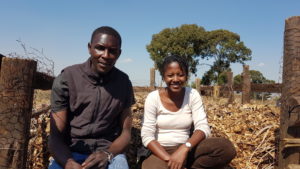
BoombaDotMobi collects organic waste from its paying customers and the wider community to transform it into compost. This is achieved through black soldier fly composting, vermicomposting and heat composting. The team then sells the quality compost product back to local farmers and their community.
With its prize money, Boombadotmobi is planning to prevent illegal waste dumping through education, and with the provision of an material recovery facility for sorting waste for recycling and composting from richer and poorer neighbourhoods in Johannesburg.
Guwahati, India
The Judges
Sumit Jugran, Sustainability and CSR Manager, Tetra Pak
Sanjib Bezbaroa, Vice President: Corporate EHS, ITC Ltd
Gautam Mehra, Deputy Team Leader of Circular Economy Solutions, Giz India
The winners in Guwahati
Inside Out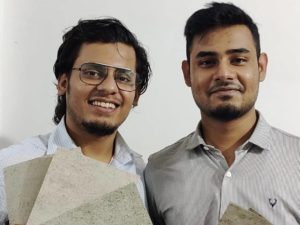
Guwahati is home to Dipor Bil, the only internationally protected wetland site in Assam, and home to many endangered species. The lake is under threat from the neighbouring dumpsite, and the invasive water hyacinth, a weed that is notorious for creating ecological imbalance.
The Inside Out duo have developed a way to make paper, fibreboard and crafts from water hyacinth, reducing the need for wood pulp and providing employment opportunities. They will use the award to employ 23 local people, including inskilled labourers for waste collection, and semi-skilled labourers for processing.
Shree Guru Plastics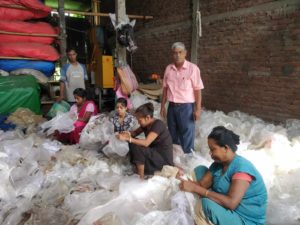
Shree Guru Plastics collects and purchases low value contaminated plastic, which is often left out from the recycling chain and ends up in dumpsites, and recycles it to produce thin film that can be used as damp course in home construction. The demand for this product is high in Northeast India, and Guwahati is a distribution hub.
Already an established business, Shree Guru Plastics is planning to use this award to increase the capacity of its facility in Guwahati, through better use of technology. With the funding, the small business can nearly double its capacity from 11 tonnes to 19 tonnes of low value plastics per month, and will be able to provide employment for 15 more women and 7 more waste collectors.
Ho Chi Minh City, Vietnam
The Judges
Sam Wood, Deputy Head, British Consulate in Ho Chi Minh City
Uyen Mai, South East Asia Sustainability Leader, Dow Chemical
Matteo Chiampo, Director of Operations, SecondMuse Singapore
Klaus Oberbauer, Programme Manager, SecondMuse Singapore
The winners in Ho Chi Minh City
VECA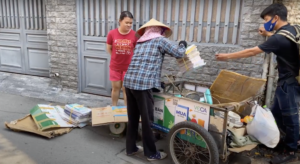
VECA is a mobile app that connects scrap collectors, sellers and dealers, supporting the sale of recyclable waste with complete transparency on prices. The app is revolutionising the way informal waste pickers work and helping to divert huge amounts of waste from landfill.
They have successfully piloted their approach in Ho Chi Minh, have over 20,000 users and work with 7 waste collectors who have all increased their income through connecting to the app.
With the prize money, VECA aims to increase their users to 100,000 and waste collector network to 75 and the number of scrap yards to 75. As a result it is estimated 5.7 tonnes of recyclables per day will be collected that otherwise would have ended up at landfill.
University of Economics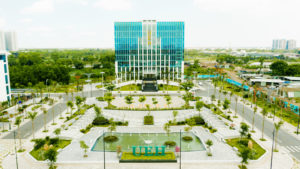
Based in Ho Chi Minh City, the University of Economics has a goal to build the first zero waste university, through the adoption of The Three R’s (reduce, reuse, recycle) and by running campaigns to raise awareness as well as to encourage behavioural change across the community on campus.
Key activities include the set up of an materials recovery facility on campus to recover organic waste, plastics and other valuables as well as an education platform with rewards for behaviour change.
WasteAid would like to extend its gratitude to all of the judges, and to congratulate all the winners of the Zero Waste Cities Challenge!
Written by Zoë Lenkiewicz
News
Beyond the Numbers: The Human Impact of WasteAid’s Work
Members of WasteAid’s Gambia team, Lamin Janneh and Jojo Saho, recently investigated what our programmes mean to our individual participants by speaking to members...
News
Journey to Uganda: Stories from our projects
Recently, the Programme Management team travelled to Uganda to meet the people at the heart of our waste management programmes, connect with local stakeholders...
News
From E-Waste Skills to Sustainable Enterprise: Cosmo City Participants Take the Next Step
What if a broken laptop, television or other electronic appliance wasn’t waste, but an opportunity to repair, reuse and recycle? For participants in WasteAid’s Waste 2...
News
Lufthansa Group and WasteAid Launch Animation Film
WasteAid and Lufthansa Group have launched a new animated training film designed to help cabin crew improve onboard waste segregation, supporting efforts to increase...
News
How one community in The Gambia is changing its relationship with plastic
In Bakoteh, a community in the Greater Banjul Area of The Gambia, plastic waste has long been a serious problem. Home to the largest dumpsite in...
News
Women farmers in Kalaji turn organic waste into opportunity through the S-ORGANIC project
In Kalaji, a group of women farmers is demonstrating how organic waste can become a productive resource — supporting sustainable agriculture, strengthening livelihoods, and...